A building block for light-linked quantum computers
13 November 2026
Researchers at LMU Munich and the Max Planck Institute of Quantum Optics have built a platform that combines two capabilities previously developed only separately: enabling single atoms to exchange information with light and letting atoms interact with one another in a controlled way. The advance brings together essential building blocks for quantum processors that can both perform computations and be interconnected via light.
Future quantum computers may not operate as isolated machines, but as networks of processing nodes linked by light. Such networks require individually controlled atoms that store quantum information, interactions between atoms that enable quantum computations, and an efficient way to exchange quantum information between atoms and particles of light, so-called photons. Until now, combining these functions in a single device has remained an open challenge.
Optical Resonator
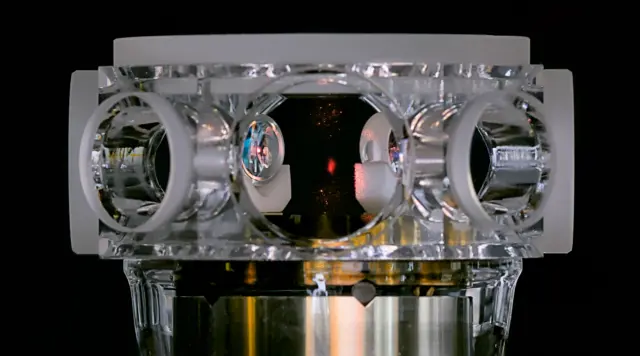 © Balázs Dura-Kovács / Zeiher Group
In their experiment, individual rubidium atoms are held in an array of optical tweezers, tightly focused laser beams that act as tiny traps. To enable the atoms to exchange information with light, the array is placed inside an optical cavity – two highly reflective mirrors facing each other. A photon entering the cavity bounces back and forth between the mirrors thousands of times, repeatedly passing through the atoms. This greatly strengthens the otherwise weak interaction between a single atom and a photon.
"It was great to see how well the electric field shielding for our high-cooperativity cavity worked in our experiment, and a relief that our initial simulations were actually quite accurate."
- Jacopo De Santis, Doctoral researcher at LMU Munich and co-first author of the study
For future quantum computations to work, however, the atoms must also interact with one another. To achieve this, they are excited to so-called Rydberg states. In these highly excited states, atoms interact strongly with their neighbors even over distances of several micrometers, thousands of times larger than the atoms themselves. These interactions are essential for elementary logic operations, known as quantum gates, in neutral-atom quantum computers.
However, combining cavities and Rydberg atoms is difficult because they react strongly to stray electric fields. Such fields can arise from the piezoelectric elements, the tiny electrically driven actuators needed to keep the cavity mirrors precisely aligned. The team overcame this obstacle by embedding these elements in a titanium platform that shields the atoms from them. This reduced the electric field at the atoms by more than a factor of ten, allowing reliable Rydberg excitation even while the cavity is being actively adjusted.
"We see this as a stepping stone toward quantum processors that talk to each other through light, and toward new ways of creating and shaping entangled states of light and matter."
- Johannes Zeiher, MCQST Principal Investigator
The measurements provide, within the same atomic array, evidence of the two types of interaction needed for building networked quantum computers. First, the atoms couple strongly to the cavity: a single atom measurably shifts the cavity’s resonance, that is, the precise color of light the mirrors let through. Second, groups of up to four atoms exhibit a collective behavior known as Rydberg blockade. When one atom is excited, it prevents its neighbors from being excited as well. As a result, the group behaves like a single “super-atom” that responds to the laser faster the more atoms it contains. This speed-up is a characteristic fingerprint of entanglement between atoms.
Building block for quantum networks
“Optical tweezers, optical cavities and Rydberg atoms have each driven remarkable progress in quantum science over the past decade. Bringing them together in a single platform lets us control the interface between light and matter at an entirely new level. We see this as a stepping stone toward quantum processors that talk to each other through light, and toward new ways of creating and shaping entangled states of light and matter,” says Johannes Zeiher, who supervised the experiment.
The new platform opens several directions: building blocks for quantum networks, generating entangled states of light, and simulating quantum materials in which particles interact over long distances. The team is now working toward deterministically entangling the atoms in specific configurations and reading them out with the cavity. Achieving this would be an important step toward implementing quantum error correction protocols, which are needed to further scale up quantum computers.
Original publication
J. De Santis, B. Dura-Kovács, M. Öncü, A. Bouscal, D. Vasileiadis, J. Zeiher,
Realization of a cavity-coupled Rydberg array
Phys. Rev. X
DOI: https://doi.org/10.1103/jgdt-d61y