Christopher Monroe: Between a Nobel lineage and start-up culture
MCQST awarded the physicist Christopher Monroe, Prof. at Duke University, with the 2026 Distinguished Lecturer Award. In this interview, he illustrates how he bridges the tradition of atomic physics and the emerging quantum computing industry.
Between a Nobel lineage and start-up culture
US physicist Christopher Monroe bridges the tradition of atomic physics and the emerging quantum computing industry
Anyone browsing Christopher Monroe’s website will come across an unusual file: the “Monroe Academic Tree”, compiled by a colleague at the University of Notre Dame, where Monroe once gave a talk. The family tree goes back deep into the history of atomic physics. “The academic tree contains your advisor, your advisor’s advisor, and so forth”, says Monroe. One of those academic ancestors was Hans Kopfermann, a defining figure in German atomic physics. Kopfermann's student was Wolfgang Paul, Nobel laureate and one of the fathers of the ion trap. Hans Dehmelt, who shared the Nobel Prize with Paul, also appears in Monroe's academic lineage. “There’s a lot of Nobel prizes in my academic lineage, which is very interesting. And it always leads to Germans.”
Christopher Monroe is one of the best-known experimental physicists in the quantum computing community. He works at Duke University in the United States and is closely associated with IonQ, the largest pure quantum computing company in the world. The systems at IonQ and in Monroe’s academic laboratories are based on individual charged atoms held in electromagnetic traps and used as qubits – the computational units of a quantum computer. Unlike classical bits, qubits can represent not only 0 or 1 but also quantum superpositions of those states. In future, this could allow certain problems to be solved far more quickly than with today's fastest supercomputers.
“It turned out we were entangling atoms for better clocks, but the same tools we were using were useful for quantum computing. And we were five years ahead of the whole world, almost by accident.”
Monroe's path into the field involved a considerable element of chance. As a young scientist, he worked in David Wineland's laboratory in Boulder, Colorado. The lab focused on atomic clocks – ultra-precise timekeeping devices. But the techniques used to control and entangle atoms turned out to be ideally suited for what was then an entirely new concept: the quantum computer. “It turned out we were entangling atoms for better clocks, but the same tools we were using were useful for quantum computing,” Monroe says. “And we were five years ahead of the whole world, almost by accident.”
The defining moment came in the summer of 1994, when Monroe attended an atomic physics conference. There, Artur Ekert, one of the early pioneers of quantum information science, spoke about Shor's algorithm – the method by which a quantum computer could factor large numbers much faster than classical computers. For Monroe, the topic was uncharted territory. “I had never heard of it. It was a totally different field, more in the area of cryptography and things.” Ekert described a new kind of computer that processes information using quantum systems. “I remember going to that talk and thinking, this is kind of interesting”, Monroe recalls. “But I didn’t know what it had to do with me.”
Others in the audience recognized the connection. Physicists Ignacio Cirac and Peter Zoller realized that the atomic systems in Wineland's laboratory were exactly the kind of building blocks needed. “They saw that talk and they recognize as theorists that the system that I was working on with Dave Wineland, these atomic clocks, it was well-suited to actually make a device.” Things then moved quickly: Cirac and Zoller proposed the concept of a trapped-ion quantum computer, and soon afterward Wineland's and Monroe's laboratory demonstrated the first experimental steps. “In a period of a few months, we actually had a paper out on a quantum gate”, says Monroe. “1994 was an amazing summer.”
What remained unclear, however, was just how broadly applicable this new form of computing would be. “If it only solves the Shor’s factoring algorithm, if it only solves a certain problem – is it more general than that?” said Monroe. “We didn’t know the answer to that.” It was precisely this uncertainty that made the field so exciting for him. Suddenly, atomic physics, mathematics, computer science, cryptography, and engineering all came together. “It was a total change in the direction of the way I approach science.”
More than three decades have passed since then – a period that has seen the transition from fundamental physics to technological implementation. “The first 10 years were more physics”, explains Monroe “In the last 20 years, we’ve really paid more attention to things that might be called engineering.” Today, the focus is less on fundamental physical breakthroughs and more on improved components, more stable hardware, and more reliable interfaces.
"Industry has a different culture, a culture of manufacturing, of reliability, of making things reliable."
To accelerate the development of practical trapped-ion quantum computers, Monroe and his colleague Jungsang Kim founded the start-up IonQ in 2016. The initiative was sparked by a venture capitalist. “He looked at our work and he said: you need to start a business, and I want to fund your business,” Monroe tells us. “Our first reaction was, thank you, but no thank you. We’re very happy in the academic setting.” But the investor remained persistent. After two years of preparation, the start-up was launched, making it possible to manufacture and scale components industrially. “A company is able to engineer in a way that we could never do at a university.”
For the academic researchers, making the leap to a start-up was a delicate step. Monroe describes the university as a place driven by curiosity and experimentation. Industry, by contrast, operates differently. “Industry has a different culture, a culture of manufacturing, of reliability, of making things reliable.” This is accompanied by the demands of raising capital, working with investors, marketing, and sales – areas in which Monroe admits he feels less at home, and which illustrate the considerable gap between a laboratory experiment and a commercial product.
The greatest technical challenge lies in scaling prototypes with only a few qubits into larger machines capable of outperforming conventional computers. The difficulty is that quantum systems must be carefully isolated from their environment; otherwise, they lose their quantum properties. To overcome this obstacle, Monroe advocates a modular architecture. Rather than packing ever more qubits into a single system, he aims to build multiple smaller systems and connect them using light – much like servers in a data center. “The idea is to build multiple systems of the same type. They’re all small, and hook them up with optical fibers, sort of like a data center.” Monroe has spent years working on exactly this interface between atomic qubits and photons traveling through optical fibers.
Today, Monroe serves as Chief Scientist at IonQ. In 2025, the company acquired several promising high-tech firms, including Oxford Ionics and Lightsynq. Oxford Ionics is developing a technology in which ions are controlled not with lasers but with microwaves – a method that could prove more precise and stable. Lightsynq is working on optical-fiber links between quantum modules, a subject Monroe has pursued for the past 20 years. “Those two aspects of our roadmap at IonQ are super exciting.”
So will quantum computing arrive as a revolution – or as a gradual evolution? “It’s hard to believe it’s just gonna be gradual,” Monroe replies. The decisive moment, he believes, will come as soon as quantum computers deliver their first commercial benefit. As soon as a logistics company cuts its costs by ten percent, for example, there will be no need for further mathematical proof. Monroe believes such a moment could arrive within the next few years: “Quantum computers suddenly are profitable, and it makes sense for businesses to use them.”
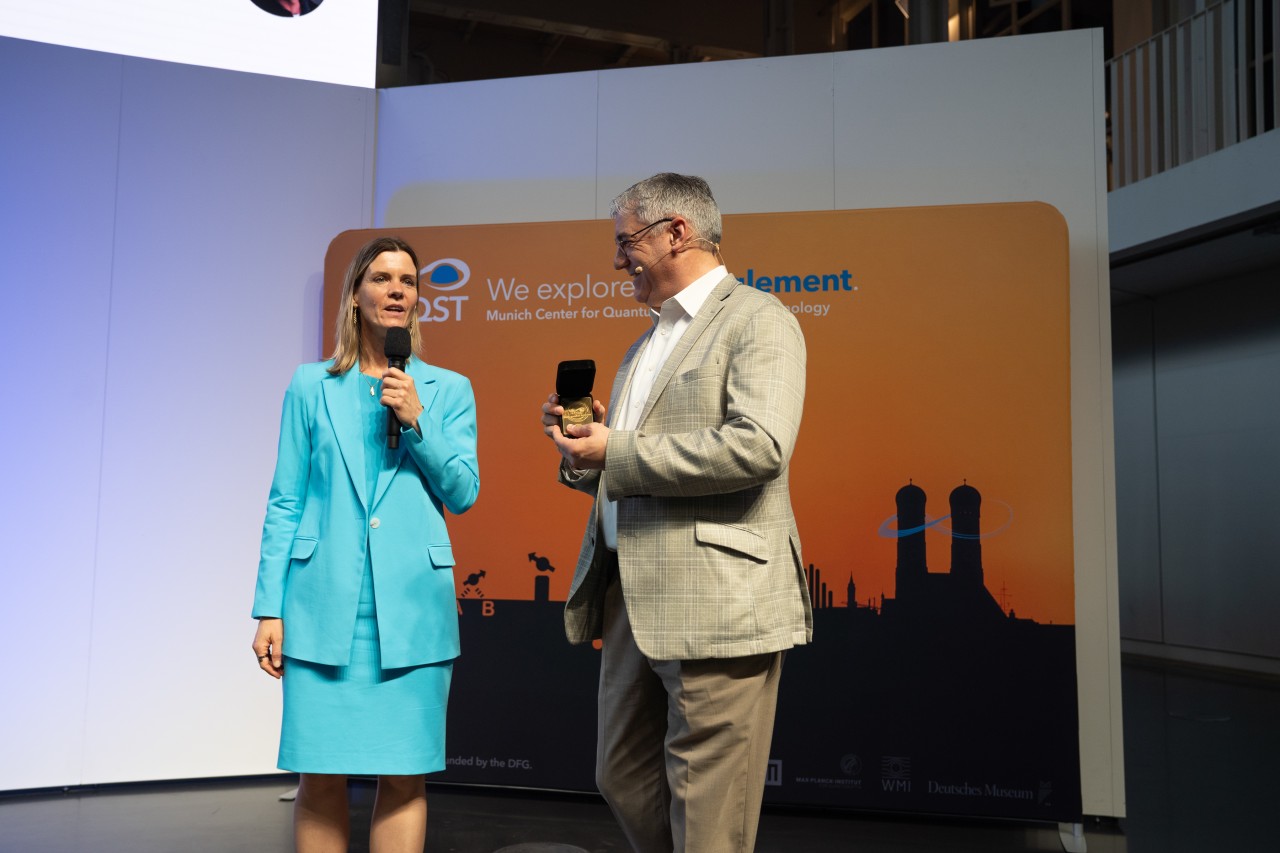
Christopher Monroe receives the Distinguished Lectuerer Award from MCQST co-Spokesperson, Barbara Kraus.
Fittingly for someone whose academic family tree is filled with legendary German physicists, Christopher Monroe is a frequent visitor to Munich and has high praise for initiatives and institutions such as the Munich Quantum Valley and the Munich Center for Quantum Science and Technology (MCQST). “These are entities that are not universities, they're not industry, they're not really government labs. They're a little bit of all of that, and they can work with all of them. And I think that's really important.”
MCQST Distinguished Lecturer
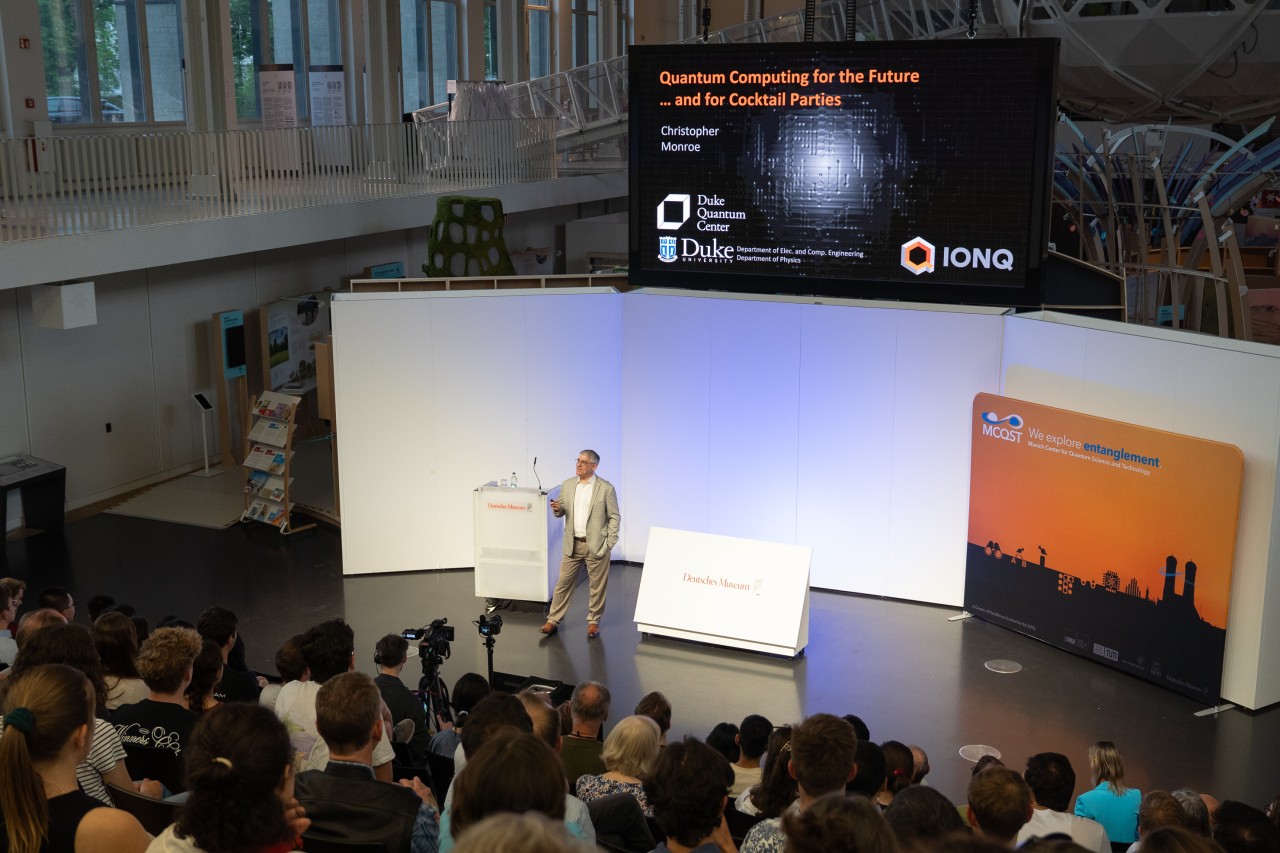
The MCQST Distinguished Lecturer prize acknowledges scientific achievements in the field of quantum science and technology, as well as a high commitment to communicate recent developments in their respective fields to a broader public. During his visit to MCQST as a Distinguished Lecturer, Christopher Monroe delivered three tailored lectures, each designed for a specific audience. He presented a colloquium for the local scientific community, a specialized seminar for researchers in his field, and a public lecture aimed at a broader audience. The public lecture, held in June 2026 at the Deutsches Museum, was recorded, and you can watch it below.