Girls for Science 2026: What a Career in Quantum Science Looks Like
6 August 2026
Girls for Science 2026: Showing Young Women What a Career in Quantum Science Looks Like
For the second year running, MCQST welcomed a new generation of curious minds to Girls for Science — a day dedicated to showing young women what a career in quantum science can look like. Over 60 students from 9th to 12th grade travelled from across Bavaria and beyond to the Max Planck Institute of Quantum Optics (MPQ) for keynote talks, a panel discussion, speed-mentoring, and behind-the-scenes lab tours.
Modeled on the Perimeter Institute's Inspiring Future Women in Science format, the event was built around one simple idea: seeing is believing. When young women meet scientists who look like them and hear how varied and human the path into physics really is, the field stops feeling abstract — and starts feeling possible.
There Is No One-Path Into Quantum Physics
Sabrina Patsch, science journalist at c't magazin von heise, opened with an introduction to quantum physics before sharing her own story: pursuing a PhD as a first-generation academic (Arbeiterkind), then moving into science journalism — proof that a physics PhD can lead into communication just as easily.
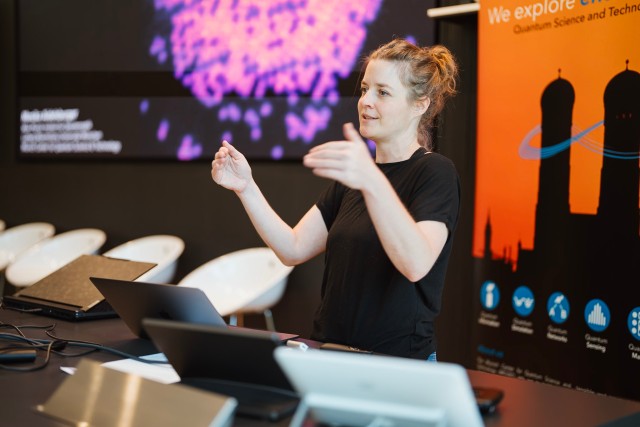
Monika Aidelsburger, Professor of Experimental Physics at LMU Munich and Group Leader at MPQ, gave a window into her research manipulating individual atoms to simulate quantum computers, cooling them with lasers to temperatures colder than outer space. Her enthusiasm for the research and insightful presentation, sparked a wave of questions and was a clear highlight of the day.
Isabella Fritsche, currently working as a quantum hardware engineer at planqc, spoke about her less conventional route into the field, about staying true to and following her passions, and about her journey at planqc — from the start-up phase to now leading a team and a project building quantum computers. She also emphasized a crucial aspect: community. Finding and supporting a network of other women in the field is essential — a reminder that lifting each other up is just as important as the science itself.
A Panel on Breaking Down Preconceptions
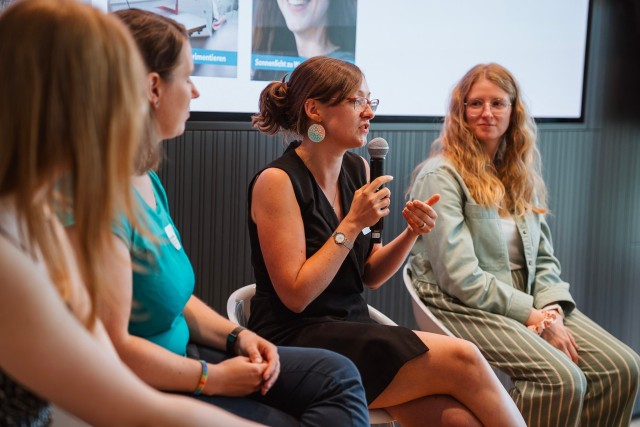
Doctoral candidate Nina Miller (TUM) moderated a panel of four researchers at different career stages, spanning academia, industry, and education. We were delighted to have Lisa Krüger (PhD at TUM), Johanna Oefele (Teaching Assistant at LMU), Dorothee Tell (Postdoc at MPQ) and Gwenaelle Vest (Head of Systems at Q.ANT GmbH) offer insights into their unique experiences.
The conversation ranged from confronting preconceptions about who belongs in physics to handling setbacks and following your own interests. One message came through clearly: a physics degree opens far more doors than people expect — shaping technology in industry, advancing research in the lab, sparking an "aha moment" by builduing experiments and running them in the lecture hall or actively building the community you wish to have.
Speed-Mentoring and Lab Tours
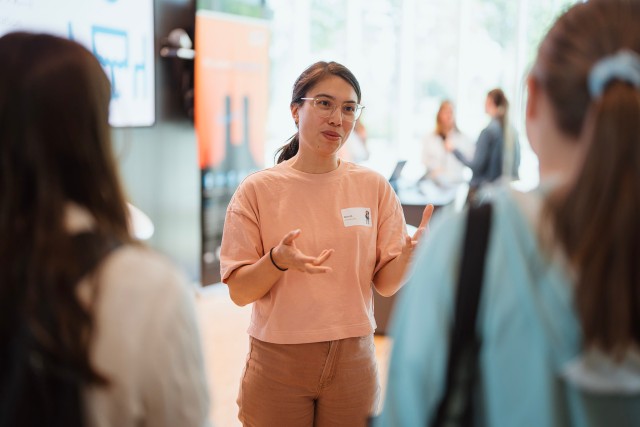
The day closed with tours through some of Munich's quantum labs: the many-body systems lab and attoworld group at MPQ, the quantum sensing lab at TUM, and planqc — all these marking the moment the day's talks became tangible.
The Takeaway
Trust your instincts, pursue what excites you, and treat setbacks as learning rather than failure — the most meaningful rewards, several speakers noted, tend to lie on the other side of the hardest problems.
A huge thank-you to all the speakers, mentors, and participants who made this year's Girls for Science a success. We're already looking forward to next year.
The event was organized by the Cluster of Excellence "Munich Center for Quantum Science and Technology" (MCQST) together with the PhotonLab, based on the concept developed by Perimeter Institute, Canada.
Further Information
- Read about our Girls for Science event and see the full line-up of speakers
- Photo impressions from the event
- Discover the school laboratory "PhotonLab"
- Read more about Perimeter Institute's "Inspiring Future Women in Science" event