ERC Starting Grants for Florian Dirnberger and Tobias Vogl
3 September 2026
Two MCQST researchers have been awarded ERC Starting Grants — one of Europe's most competitive funding schemes. Their projects will push the frontiers of semiconductor physics and explore efficient and secure communication for the quantum internet.
These grants are awarded annually in various categories. Through its Starting Grants, the ERC supports outstanding researchers at the early stages of their independent careers. Each grant is worth up to €1.5 million.
Van der Waals magnetic semiconductors are magnetic, but also function as semiconductors. They contain ‘excitons’, optical quasiparticles, as well as ‘magnons’, magnetic excited quasiparticles. In the ‘WAVES’ project, the researchers are investigating coupled quasiparticles in solids. By combining optical lasers with microwaves and magnetic fields, excitons and magnons can be precisely controlled. The aim is to use a new (stroboscopic) imaging technique to replicate quantum physics experiments and gain a better understanding of exciton transport using ultra-fast microscopy. Using ultra-thin samples, the researchers aim to uncover new relationships among excitons, magnons, and transport phenomena associated with quantum mechanics, and, as part of a holistic approach, to measure both quasiparticles spatially and temporally to detect novel interaction effects. The researchers hope that WAVES will yield new insights at the frontiers of semiconductor physics, magnetism and optics, as well as greater clarity regarding the potential of quasiparticles in solids.
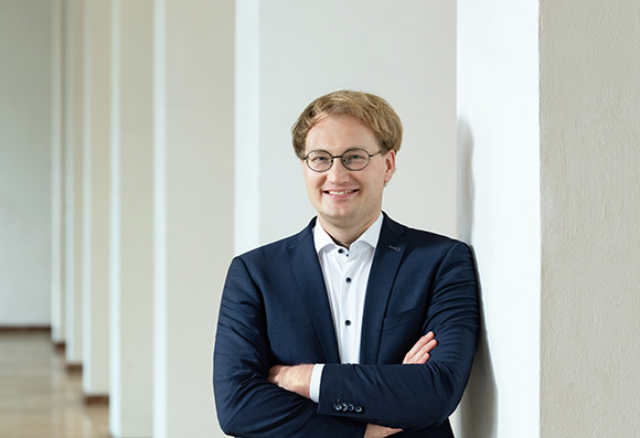
Florian Dirnberger conducts research in the Excitonic Quantum Materials Research Group at the TUM School of Natural Sciences.
Since scattering and absorption are significant only in the lowest 10 km of the atmosphere, satellites could enable long-distance quantum communication in the future. However, satellite-based quantum communication faces certain limitations: The satellites use only weak lasers, which results in a low data rate. In addition, quantum information can only be transmitted at night. The QUCONAT project aims to overcome these hurdles. To this end, the team led by Prof. Tobias Vogl is developing a compact single-photon source that specifically generates individual photons and functions even under space conditions. A special filter is designed to distinguish the quantum signal from sunlight, even in daylight. This will also significantly increase the effective data rate. As a result, smaller satellites could establish secure quantum connections in the future and provide key building blocks for a European quantum internet. Mobile systems for direct connections within cities are also conceivable.
Tobias Vogl is a professor of Quantum Communication System Engineering at the TUM School of Computation, Information, and Technology.
Congratulations to both researchers and their teams!
 © A. Heddergott / TUM
  © U. Benz / TUM