Springboards into the Quantum Realm
MCQST proudly awarded the physicist Markus Aspelmeyer of the University of Vienna and the Austrian Academy of Sciences with the 2025 Distinguished Lecturer Award. In this interview, he reflects on his path into quantum physics and his exploration of the interplay between the microworld and gravity.
Where are the limits of quantum physics? At what point does it merge with the most mundane of natural forces—gravity? To investigate these questions, Vienna-based physicist Markus Aspelmeyer manipulates tiny gold beads, barely heavier than ladybugs, and measures the gravitational forces between them. In other experiments, he suspends glass particles containing billions of atoms in finely balanced setups. And he uses laser light to bring microscopic springboards to a standstill—until their movement must be described by the laws of quantum mechanics. In doing so, the researcher is gradually approaching a fascinating puzzle: Is space-time not structured in the way Albert Einstein once described it?
While studying physics in Munich, Aspelmeyer was already interested in the most fundamental questions. “During my studies, I had many friends from philosophy and theology with whom I had interesting discussions,” he says. “That led me to also enroll at the Munich School of Philosophy as well.” There, the young physicist learned to sharpen his concepts, test assumptions, and experiment mentally—a school that later proved useful in the laboratory. “Always questioning critically—that’s what I took away with me,” explains Aspelmeyer. “In experimental physics, this helps you to avoid jumping to conclusions and saying, our experiments prove this and that. Instead, you ask, ‘What assumptions can we rule out?’”
“I asked myself: What interests me most—and what do I know least about?” The answer: quantum physics.
In his doctoral thesis, he focused on solid-state physics, studying X-ray scattering and material properties—a classic, solid path. But then came a moment of reorientation. “I asked myself: What interests me most—and what do I know least about?” The answer: quantum physics. His interest in this field began early on. As a teenager, Aspelmeyer devoured Stephen Hawking’s A Brief History of Time —a bestseller that was virtually impossible to ignore in the 1990s. But it was only after completing his doctorate that he followed his youthful curiosity and decided to change his academic path. However, “I knew very little about quantum mechanics at the time, so I had to familiarize myself with it first,” he explains. “I followed the advice of many colleagues: If you want to learn something properly, you have to go to the best!”
Markus Aspelmeyer took the advice literally and called Anton Zeilinger, the Vienna-based pioneer of quantum physics and later Nobel Prize winner. Zeilinger actually accepted him into his team as a career changer—“an incredible stroke of luck,” Aspelmeyer says today. “As a doctor of physics, I entered an environment where even second-semester students knew more about quantum physics than I did—it was a mixture of maximum frustration and maximum motivation.”
But Aspelmeyer learned quickly and soon struck out on his own. While quantum physics traditionally deals with the smallest systems—atoms, electrons, molecules—he turned his attention to larger objects. The decisive impetus came in 2004, during a talk given by Italian theorist Paolo Tombesi. “‘He was speculating on how the idea of quantum teleportation could be applied to mechanical objects,” recalls Aspelmeyer. “I walked out of there and knew: That’s what I want to do!”
This marked the beginning of a research program that balances at the interface of light and mechanics: quantum optomechanics. Aspelmeyer’s team started by building tiny mechanical systems—microscopic springboards with mirrors on them—whose movement they bring to a standstill using laser light. The principle is known from atomic physics: Targeted interactions between light and matter can slow down motion and cool it down to its quantum mechanical ground state. “We thought: What works with one atom must also work with many.”
Using this method, the team succeeded for the first time in preparing macroscopic objects—glass beads containing billions of atoms—in such a way that their motion can only be described by the laws of quantum physics. “We have shown that mechanical systems can be brought into the quantum regime even at room temperature,” explains Aspelmeyer. Such objects can be understood not only as model systems, but also as interfaces: Mechanical quantum objects can couple magnetic, electrical, or optical degrees of freedom with one another—a potential that opens up applications in sensor technology and quantum information.
 © MCQST
 Pushing the boundaries between quantum mechanics and gravity
Aspelmeyer is particularly interested in the fundamental aspects. His experiments push the boundaries between quantum mechanics and gravity—two theories that have barely intersected until now. “If you bring a massive object into the quantum regime, you can, in principle, measure its gravitational field,” he explains. “And then you suddenly open up a whole new chapter.”
Together with his team, he miniaturized the famous Cavendish experiment, which was used in the 18th century to determine the gravitational constant for the first time. Instead of lead beads weighing several kilograms, he used tiny gold beads weighing only 90 milligrams—the smallest objects whose gravitational interaction has ever been measured. “Our little gold bead is basically the equivalent of the Earth—only it has the mass of a ladybug,” explains the physicist. “And the acceleration it generates is thirty billion times smaller than that of the Earth.”
"If you bring a massive object into the quantum regime, you can, in principle, measure its gravitational field. And then you suddenly open up a whole new chapter.”
In the long term, Aspelmeyer wants to use such systems to investigate whether gravity itself obeys the laws of quantum physics—in other words, whether a superposition of gravitational fields can exist. This is still a distant goal, but the path seems clear: “We are building gravitational experiments that measure ever smaller masses and quantum experiments that involve ever larger objects. One day, the two scales could converge.”
Essentially, this concerns the compatibility of two fundamental pillars of physics. If, from a quantum physics perspective, a mass were to exist in a spatial superposition—i.e. both here and there at the same time—this could also apply to its gravitational field. If this effect could be proven experimentally, it would contradict the general theory of relativity, which always assigns a uniquely determined space-time to a mass. “Then we would have an experiment that would show: There is a gravitational phenomenon that can no longer be described by Einstein’s theory!”
In addition to his basic research, Aspelmeyer also ventured into practical applications. Together with his colleague Garrett Cole, he founded the company Crystalline Mirror Solutions. The starting point was a chance discovery in the laboratory: A new material system that exhibited better mechanical properties than conventional mirror coatings. What began as an idea for a “good story in a paper” became a technology that is now marketed by a US company and used worldwide in precision lasers. “It was fascinating to see how a completely unrelated question in fundamental quantum physics led to the development of a new mirror technology.”
In his work, Markus Aspelmeyer combines two very different spheres: That of philosophy, which develops concepts and world views, and experimental physics, which uses sophisticated methods to make the invisible measurable. And his curiosity continues to drive him forward—to where quantum physics and gravity may one day converge.
MCQST Distinguished Lecturer
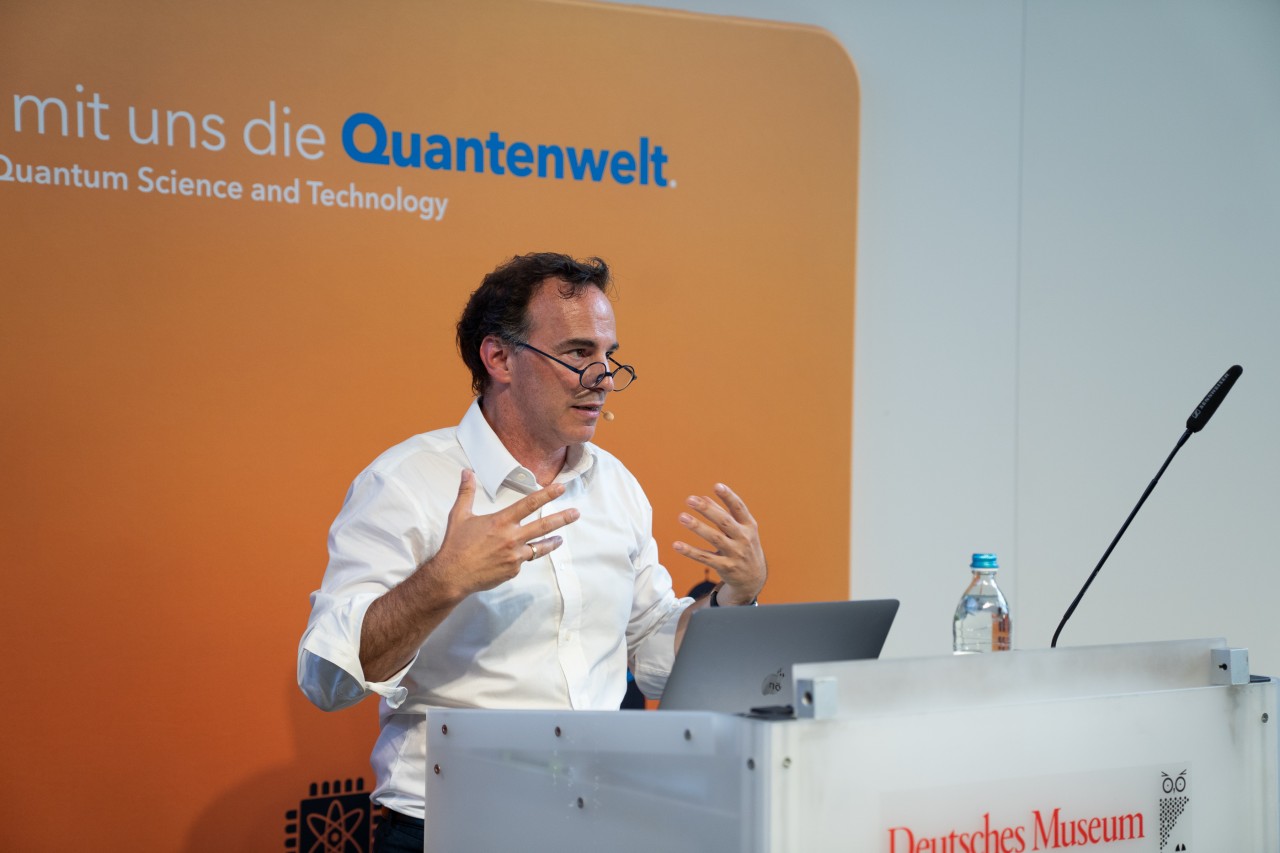
During his visit to MCQST as a Distinguished Lecturer, Markus Aspelmeyer delivered three tailored lectures, each designed for a specific audience. He presented a colloquium for the local scientific community, a specialized seminar for researchers in his field, and a public lecture aimed at a broader audience. The public lecture, held in Juli 2025 at the Deutsches Museum, was recorded, and you can watch it below (orginally in German language).