Quantum Computers for the Future (and for Cocktail Parties)
17 June 2026
from 19:00
to 20:30
Public Talk | Distinguished Lecturer, Prof. Christopher Monroe (Duke University) offers insights into the quantum computers of the future at Deutsches Museum.
Address / Location
Deutsches Museum
Museumsinsel 1
80538
München
Show Map
Hide Map
As MCQST Distinguished Lecturer, Prof. Christopher Monroe (Duke University) is giving a series of lectures aimed at various audiences. This public lecture is open to anyone interested in quantum science—including complete beginners!!
Quantum Computers for the Future (and for Cocktail Parties)
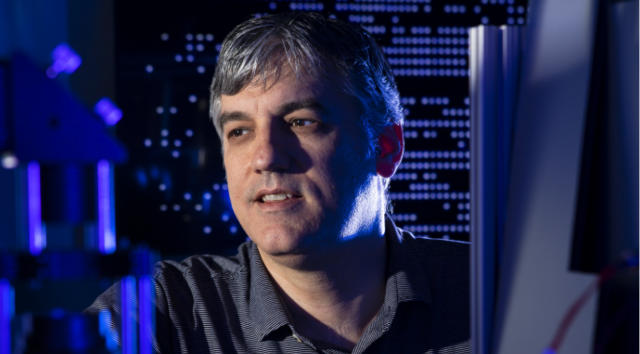
Christopher Monroe | Duke University
Quantum computers exploit the bizarre features of quantum physics – uncertainty, fuzzy states of reality, quantum entanglement -- to perform tasks that are impossible using conventional means. These include the computing and optimizing over ungodly amounts of data; breaking encryption standards; simulating models of chemistry and materials; and communicating via quantum teleportation. However, quantum computers are notoriously hard to build and scale. Despite this, many important problems known and unknown will never be solved until we have them, so society is well-motivated. I will discuss the state-of-the-art in this remarkable field, led by scientists and engineers from academia, industry and government.
About Christopher Monroe
Registration
Registration is closed.
After registering, you will receive a confirmation email containing a QR code, which you need present at the entrance. The lecture, which will be held in English, begins at 7:00 p.m., and there will be an opportunity to ask the speaker questions afterward. Please note that doors open at 6:30 p.m.
About the Munich Center for Quantum Science and Technology (MCQST)
Researchers at MCQST explore the science behind complex quantum systems and are helping to build the technologies that will shape the 21st century. Their work spans some of the most exciting frontiers in modern science — from quantum computers and advanced information systems to ultra-precise quantum sensors and entirely new kinds of materials.
MCQST was founded in 2019 as a collaboration between LMU Munich, TU Munich, the Max Planck Institute for Quantum Optics, the Walther Meissner Institute of the Bavarian Academy of Sciences, and the Deutsches Museum. It is funded by the German Research Foundation (DFG).
Every year, MCQST presents its Distinguished Lecturer Award to a researcher who has made outstanding contributions to quantum science and technology — and who shares that knowledge with the wider world.