


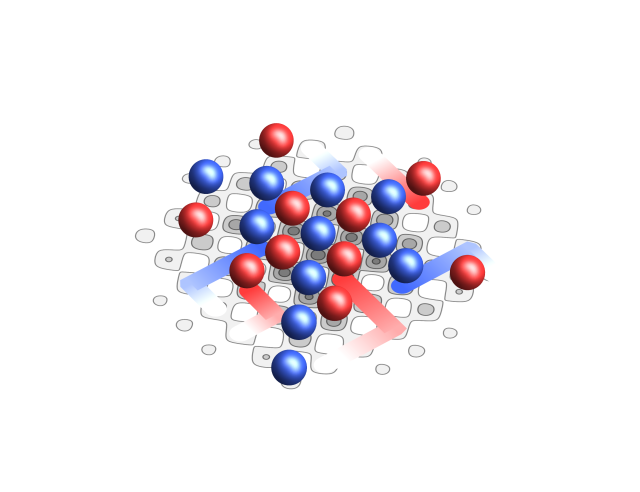

Modular quantum gas platform
T. Hammel, M. Kaiser, D. Dux, P. M. Preiss, M. Weidemueller, S. Jochim
Physical Review A 111 (3), 33314 (2025).
We report on the development of a modular platform for programmable quantum simulation with atomic quantum gases. The platform is centered around exchangeable optical modules with versatile functionalities. The performance of each module is disentangled from all others, enabling individual validation and maintenance of its outputs. The relative spatial positioning of the modules with respect to the position of the atomic sample is set by a global reference frame. In this way, the platform simplifies reconfiguration and upgrading of existing setups and accelerates the design of new machines in a time- and cost-efficient manner. Furthermore, it facilitates collaborations between different experimental groups. This standardized hardware design framework, which we call Heidelberg Quantum Architecture, paves the way towards a new generation of on-demand and highly adaptable quantum simulation experiments.
Simulating Chemistry with Fermionic Optical Superlattices
F. Gkritsis, D. Dux, J. Zhang, N. Jain, C. Gogolin, P. M. Preiss
Prx Quantum 6 (1), 10318 (2025).
We show that quantum-number-preserving ansatzes for variational optimization in quantum chemistry find an elegant mapping to ultracold fermions in optical superlattices. Using native Hubbard dynamics, trial ground states of molecular Hamiltonians can be prepared and their molecular energies measured in the lattice. The scheme requires local control over interactions and chemical potentials and global control over tunneling dynamics, but foregoes the need for optical tweezers, shuttling operations, or longrange interactions. We describe a complete compilation pipeline from the molecular Hamiltonian to the sequence of lattice operations, thus providing a concrete link between quantum simulation and chemistry. Our work enables the application of recent quantum algorithmic techniques, such as double factorization and quantum tailored coupled cluster, to present-day fermionic optical lattice systems with significant improvements in the required number of experimental repetitions. We provide detailed quantum resource estimates for small nontrivial hardware experiments.
Engineering single-atom angular momentum eigenstates in an optical tweezer
P. Lunt, P. Hill, J. Reiter, P. M. Preiss, M. Galka, S. Jochim
Physical Review A 110 (6), 63315 (2024).
We engineer angular momentum eigenstates of a single atom by using an all-optical approach based on the interference of Laguerre-Gaussian beams. We confirm the imprint of angular momentum by measuring the twodimensional density distribution and by performing Ramsey spectroscopy in a slightly anisotropic trap, which additionally reveals the sense of rotation. This article provides the experimental details on the quantum state control of angular momentum eigenstates reported in P. Lunt et al., Phys. Rev. Lett. 133, 253401 (2024).
Realization of a Laughlin State of Two Rapidly Rotating Fermions
P. Lunt, P. Hill, J. Reiter, P. M. Preiss, M. Galka, S. Jochim
Physical Review Letters 133 (25), 253401 (2024).
We realize a Laughlin state of two rapidly rotating fermionic atoms in an optical tweezer. By utilizing a single atom and spin resolved imaging technique, we sample the Laughlin wave function thereby revealing its distinctive features, including a vortex distribution in the relative motion, correlations in the particles' relative angle, and suppression of the interparticle interactions. Our Letter lays the foundation for atom-byatom assembly of fractional quantum Hall states in rotating atomic gases.
Skyrmion ground states of rapidly rotating few-fermion systems
L. Palm, F. Grusdt, P. M. Preiss
New Journal of Physics 22 (8), 83037 (2020).
We show that ultracold fermions in an artificial magnetic field open up a new window to the physics of the spinful fractional quantum Hall (FQH) effect. We numerically study the lowest energy states of strongly interacting few-fermion systems in rapidly rotating optical microtraps. We find that skyrmion-like ground states with locally ferromagnetic, long-range spin textures emerge. To realize such states experimentally, rotating microtraps with higher-order angular momentum components may be used to prepare fermionic particles in a lowest Landau level. We find parameter regimes in which skyrmion-like ground states should be accessible in current experiments and demonstrate an adiabatic pathway for their preparation in a rapidly rotating harmonic trap. The addition of long range interactions will lead to an even richer interplay between spin textures and FQH physics.