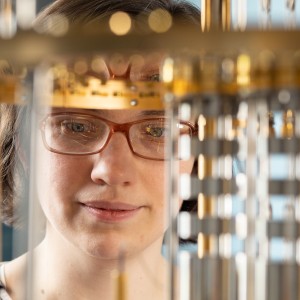



Nadezhda Kukharchyk working on the electrical contacts of a quantum computer.

Microwave quantum communication and sensing with spin systems

Walther Meißner Institute

Bayerische Akademie der Wissenschaften

Walther-Meißner-Straße 8

85748 Garching

+49 (0) 89 289 14226

Nadezhda.Kukharchyk[at]wmi.badw.de

Research Website

Research is a lifelong adventure of learning, trying, failing, finding new ways and sharing your knowledge with others.

Description

A reliable quantum memory system is now actively searched for among different types of solid-state systems. In particular, rare-earth doped spin ensembles, which possess favorable transitions in optical and microwave ranges, are promising candidates.

The current project aims at developing a quantum memory system based on rare-earth spin ensembles. Such quantum memory elements should work at zero magnetic field at ultra-low temperatures. The major task of the project is to implement optical techniques, such as spectral hole burning and frequency comb, into the microwave regime.

Research focus
The focus of my research lies within the rare earth ions as potential building blocks of the quantum-computing infrastructure. The rare earth ions, else lanthanides, are known for their outstanding semi-shielding feature: the 4-f electrons are partially shielded from the external fields by the outer 6s electrons. With this when placed inside a crystal, they can be treated similar to ions in a trap. I investigate their optical and microwave properties and look for methods to implement their advantages for the interest of quantum information field.


Featured

Publications

Broadband electron paramagnetic resonance spectroscopy of 167Er:7LiYF4 at millikelvin temperatures

A. Striric, P. Oehrl, A. Marx, P. A. Bushev, H. Huebl, R. Gross, N. Kukharchyk

Physical Review B 111 (21), 214430 (2025).

Show Abstract

Rare-earth spin ensembles are a promising platform for microwave quantum memory applications due to their hyperfine transitions, which can exhibit exceptionally long coherence times when using an operation point with zero first-order Zeeman (ZEFOZ) shift. In this work, we use broadband electron paramagnetic resonance (EPR) spectroscopy on 167Er:7LiYF4 single crystals at subkelvin temperatures. By fitting the spin Hamiltonian to the zero-field spectrum, we obtain refined parameters of the magnetic field-independent interactions, such as the hyperfine and quadrupole interaction. We also study the influence of the quadrupole interaction on the hyperfine splitting in the zero and low magnetic field range by analyzing EPR spectra between 0 mT and 50 mT. Our findings highlight the broadband EPR spectroscopy approach as a powerful tool for the precise determination of the spin Hamiltonian parameters and for the characterization of hyperfine transitions in terms of their selection rules and linewidth.

10.1103/5j7f-wfyl

Scroll to top