"Science advances when we dare to try."
Pascal Weckesser | Meet the MCQSTians: In this series, we regularly feature members of the MCQST community and offer insights into their research and career.
Pascal Weckesser's research interest lies in harnessing ultracold atoms to study quantum many-body systems. His fascination for ultracold atoms began during his Bachelor’s studies in Heidelberg, where Pascal encountered the field in lectures, seminars, and lab courses. Up to his Master’s, he primarily focused on theory, which he found very engaging, but upon starting his PhD, the physicist transitioned to the experimental side. Here, he joined the group of Tobias Schätz in Freiburg. Since then, Pascal has been working with a variety of experimental platforms, including laser-cooled ions and atoms during his PhD, and ultracold atoms and molecules under a quantum gas microscope during his postdoctoral work.
What always drew Pascal to this field is its unique combination of precision and creativity. It’s like an atomic sandbox—offering high control, precise tunability, and detailed detection—where you’re not just an observer but an active designer, testing the very limits of quantum physics on a single-particle level. Throughout his studies and career, Pascal has followed his curiosity, pursuing the areas that genuinely excite him—always chasing that special thrill that comes from building and exploring new quantum systems.
Can you briefly explain your research within the START Fellowship?
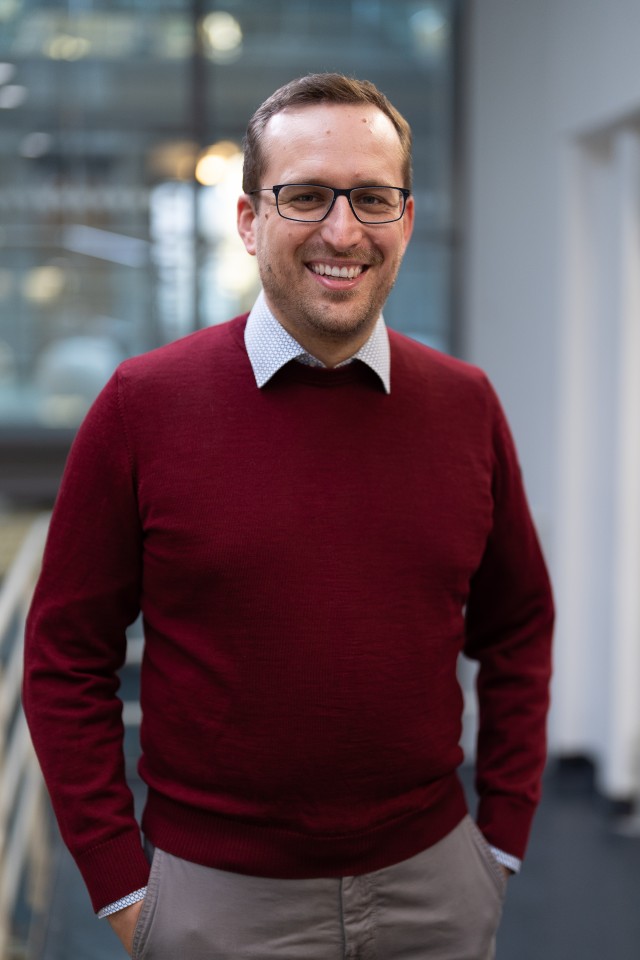
Did you always want to be a quantum scientist when you were younger? And if you weren't a scientist, what do you think you would be doing now?
From an early age I knew I wanted a career that combined mathematics and engineering. I spent hours solving mathematical puzzles and building small projects – model airplanes were my first “laboratory”. For most of my time as teenager, I was extremely interested in aerospace engineering – probably I would be working in this area if it weren’t for my high school teachers.
During my final high school years, I was lucky to have an inspiring physics teacher who really sparked my enthusiasm for the subject. Together with him we attended the “Saturday Morning Physics” program by the University of Darmstadt, which was incredibly fun and eye-opening for me. That’s when I realized I wanted to do something with physics, as it offers such a broad spectrum of topics to explore.
What drew you to Munich (and MCQST)?
Munich offers an excellent research environment, both in general and in quantum science in particular. Here, many leading experts and their groups come together, providing opportunities for interdisciplinary scientific exchange and collaboration. Having theorists and experimentalists within the same building truly facilitates discussions, sparking numerous new research directions while quickly grabbing a coffee. On a more personal level, Munich also provided opportunities for dual careers, allowing both my wife and me to pursue our professional goals.
What advice would you give to someone at the beginning of their career?
Allow yourself to fail, learn from it, and improve next time. At the same time, remember that progress takes time, and don’t be too harsh on yourself. We often compare ourselves to others, but it’s important to realize that everyone struggles in their own way. I’ve spoken with many PhD students, and all of them experience doubts and concerns at some point.
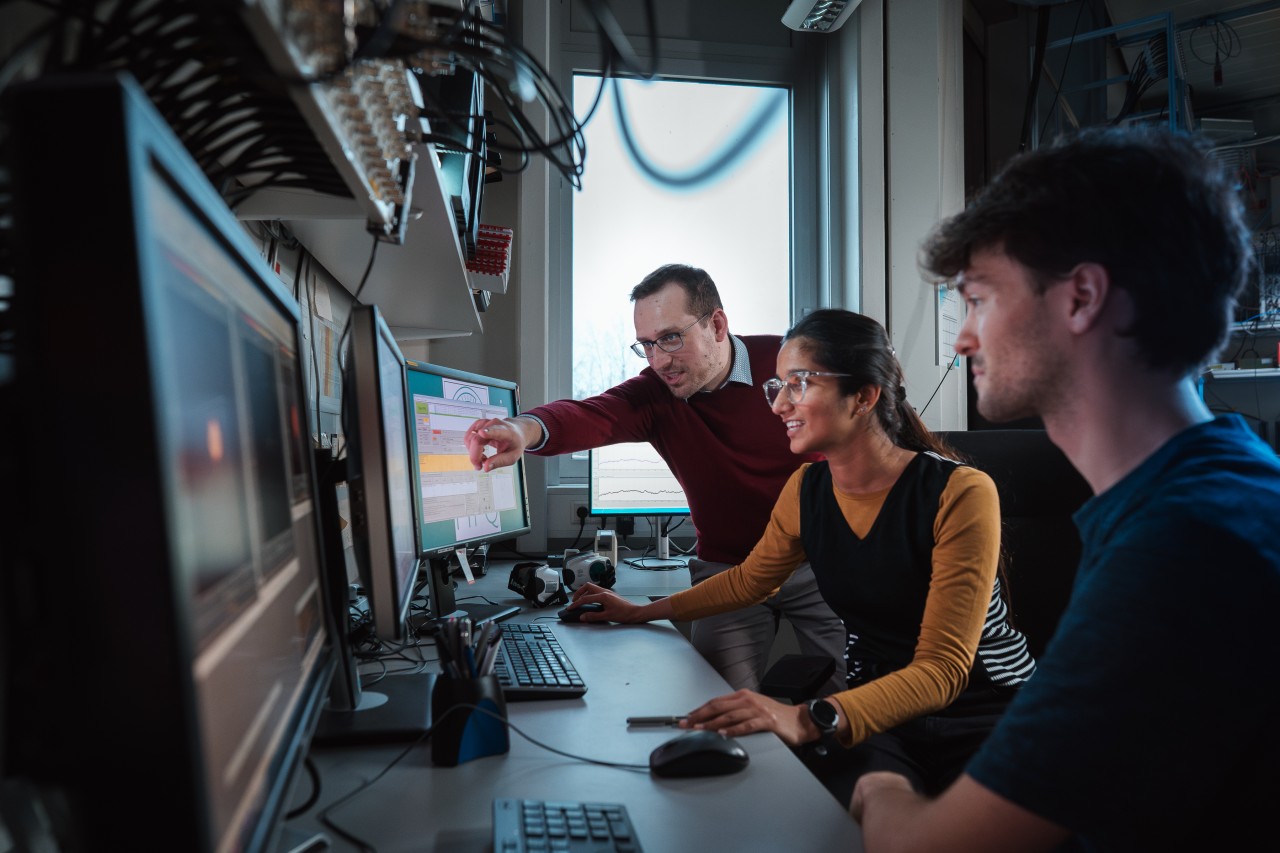
"Allow yourself to fail, learn from it, and improve next time. At the same time, remember that progress takes time, and don’t be too harsh on yourself."
What was your most memorable moment or proudest achievement in your research thus far?
In March 2020, the COVID pandemic was just beginning, and new regulations were being put in place. My institute in Freiburg informed us that it would be closed in two days, and everyone needed to prepare to work remotely. At the time, I was approaching the end of my PhD, and I realized this would be my last chance to try an experiment. I decided to use those two days to give it a shot.
Remarkably, it got it running on the very first day, and I spent the second day confirming my observation. Luckily, having this signal, I received a special approval from the university to stay in the lab while the university was in shutdown. In these isolated three months I was able to continue measuring, gathering the main results of my PhD. These findings were a major step forward for the atom-ion community, which earned me the SAMOP Dissertation Prize by DPG. And all of this came from taking a chance during those two days. Science advances when we dare to try.
Outside of science, what do you enjoy doing most?
I enjoy spending time with my 8-month-old son, making him laugh, discovering our neighborhood on walks with the stroller, and even exploring science together. On weekends, I like to take time for cooking — lasagna and special pancakes are some of my favorites — which is a hobby that my wife particularly appreciates.
Find out more about the START Fellowship and Pascal's research.