"I think mostly that there is still so much we don’t know, so much left to discover and understand."
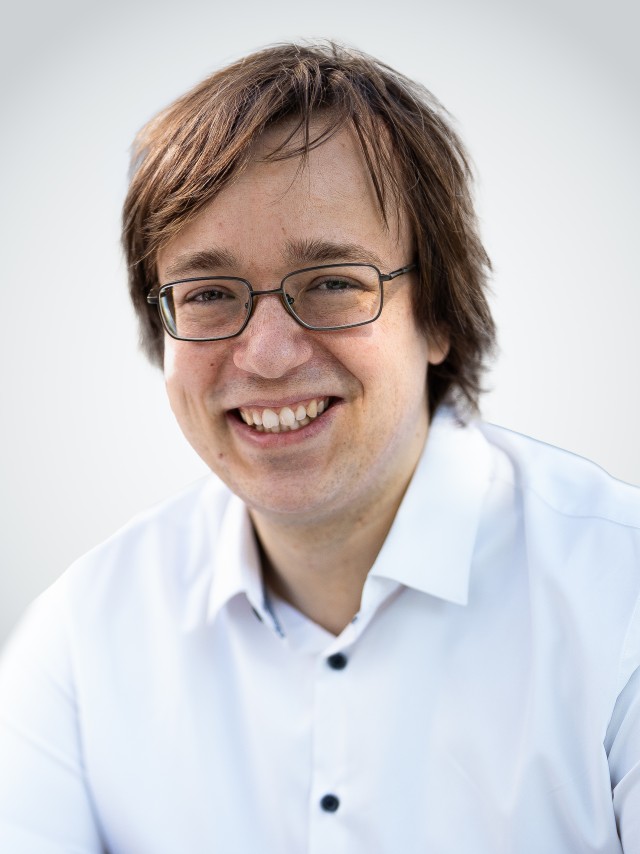
Marko Ljubotina | Meet the MCQSTians: In this series, we regularly feature members of the MCQST community and offer insights into their research and career.
Marko Ljubotina completed his PhD in the groups of Tomaž Prosen and Marko Žnidarič at the University of Ljubljana, where he began working on quantum many-body systems, with a primary focus on dynamics in integrable models, integrable circuits, and disordered systems.
He then joined the group of Maksym Serbyn at the Institute of Science and Technology Austria, working on topics such as quantum many-body scars, quantum fragmentation, quantum control with tensor networks, and classical shadows, while continuing his research on transport in quantum many-body systems.
These closely connected research directions now form the core of his work as a START Fellow at MCQST.
Can you briefly explain your research within the START Fellowship?
The primary goal of the START Fellowship is to deepen our understanding of the effects of symmetries and constraints on dynamics in quantum many-body systems. We have observed before that, for example, SU(2) symmetry (or higher symmetries) in integrable models can lead to a specific type of superdiffusive dynamics for the spin. Similarly, it has recently been observed that constrained systems likewise exhibit various types of exotic dynamics. However, thus far, these have mostly been individual results that appear almost randomly. I wish to systematically study the various types of dynamics that can result from constraints or symmetries to determine whether one can classify these behaviors in universality classes and identify the conditions under which they appear.
What are you most looking forward to as a START Fellow?
Did you always want to be a quantum scientist when you were younger?
I suppose that depends on how far back you want to go. When I was a child, I am pretty sure I did not know what a quantum scientist was. According to my parents, my dream careers were either an astronaut or a garbage collector.
Later on, though, I think I simply followed the path many students take, until I eventually stumbled upon a problem that I found I was really interested in. During my undergraduate studies, I worked in a few experimental labs for a few summers, but it turned out not to be as interesting to me. Then, during the summer between my first and second years of Master’s studies, I decided to try theory, mostly because the classes offered by the professors sounded interesting. In fact, I think the choice for the specific field is to a large degree dependent on the professors one has at that point; they are what can make the field look interesting before you get to know it yourself, and once you do, I think most fields are probably interesting.
What drew you to Munich (and MCQST)?
Well, when it comes to my field of research, Munich (and MCQST) probably offers the greatest concentration of people working in the field. As such, it is an amazing place to conduct research. There are experts on everything, and while it is true that you can usually Zoom with almost anyone, being able to discuss in person with an expert on just about anything is undeniably better. In a sense, it’s part of the benefit of conferences, only it is available all the time.
"I would say that the most important thing is to find someone with whom you get along. [...] and that you enjoy what you do. If you don’t, you will lose the passion for it, and you can’t really do science without that."
What advice would you give to someone at the beginning of their career?
If you mean someone looking to do a PhD? I would say that the most important thing is to find someone with whom you get along. It does not matter if they are extremely renowned (or if their institution is), of course, it helps tremendously, but it is more important that you enjoy what you do. If you don’t, you will lose the passion for it, and you can’t really do science without that.
What is it about your field of research that gets you most excited?
I think mostly that there is still so much we don’t know, so much left to discover and understand.
Outside of science, what do you enjoy doing most?
Spending time with friends and family, hiking, and climbing.
Find out more aboout the START Fellowship and Marko's research.