"I was curious about how the world works, and physics seemed the best way to ask big questions."
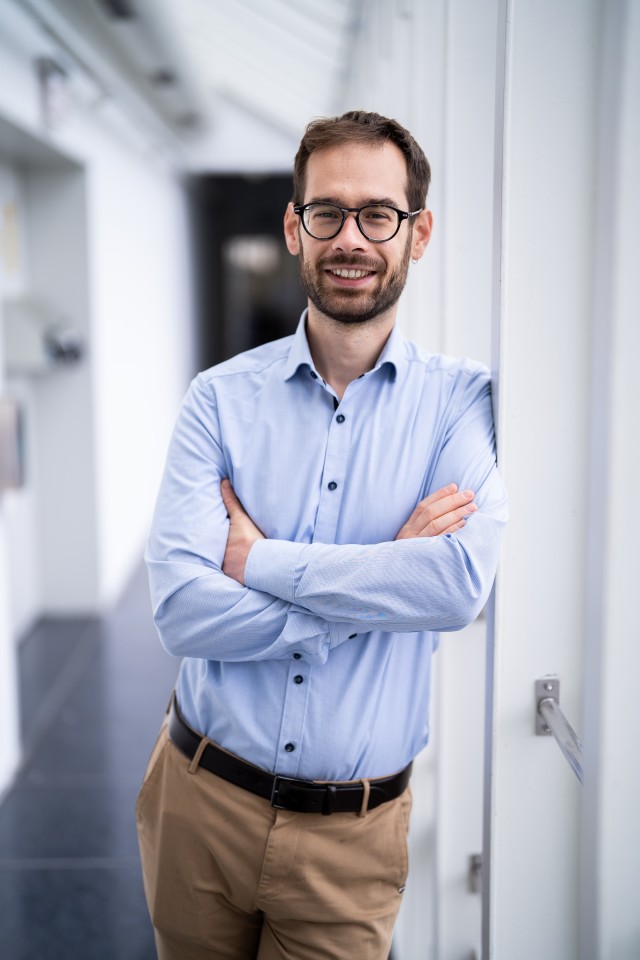
Georgios Styliaris | Meet the MCQSTians: In this series, we regularly feature members of the MCQST community and offer insights into their research and career.
Georgios Styliaris has been an MCQST START Fellow since September 2025 and is hosted in the Theory Division of the Max Planck Institute for Quantum Optics, led by Ignacio Cirac. During his fellowship, he aims to establish an independent research group working at the interface of quantum information theory and many-body physics.
He joined MPQ in 2020 as a Postdoctoral Researcher and Humboldt Fellow. Before that, he was part of the Physics Department at the University of Southern California in Los Angeles, where he obtained his PhD in Quantum Information Theory. His doctoral thesis received the CAMS Graduate Student Prize awarded by the Department of Mathematics. Originally from Greece, Georgios earned his bachelor’s degree in Physics (valedictorian) from the University of Athens in 2015, specializing in Nuclear and Particle Physics.
Bit of background: tell us a bit about your background and research interests.
I am a theoretical physicist working at the intersection of quantum information and many-body physics. My research focuses on understanding what quantum technologies can and cannot do, and on developing new methods to make quantum simulation more powerful.
Can you briefly explain your research within the START Fellowship?
Within the START Fellowship I will explore how quantum measurements can be used not just to read out information, but as an active resource for preparing complex quantum states. By combining ideas from quantum information with tensor-network methods, I aim to design protocols that bring challenging quantum simulations closer to experiment.
"I was mostly curious about how the world works, and physics seemed the best way to ask big questions with mathematical rigor."
What are you most looking forward to as a START Fellow? What are your main research goals?
I look forward to building my own team and exploring new ideas together. My main goal is to establish efficient methods for quantum state preparation that are both mathematically rigorous and experimentally relevant.
Did you always want to be a quantum scientist when you were younger? And if you weren't a scientist, what do you think you would be doing now?
Not exactly — I was mostly curious about how the world works, and physics seemed the best way to ask big questions with mathematical rigor. If I weren’t a scientist, I could imagine being a chef.
What is it about your field of research that gets you most excited?
I am fascinated by how abstract concepts from mathematics and information theory can turn into practical tools for quantum technologies.
Outside of science, what do you enjoy doing most?
I enjoy reading novels, Latin American literature especially, as well as spending time outdoors and cooking with friends and family.
Find out more about the START Fellowship and Georgios research.