Twisting Into Focus: A highly sensitive Quantum Microscope
26 March 2026
New Microscope Reveals Hidden Electron Interactions in Graphene at Room Temperature
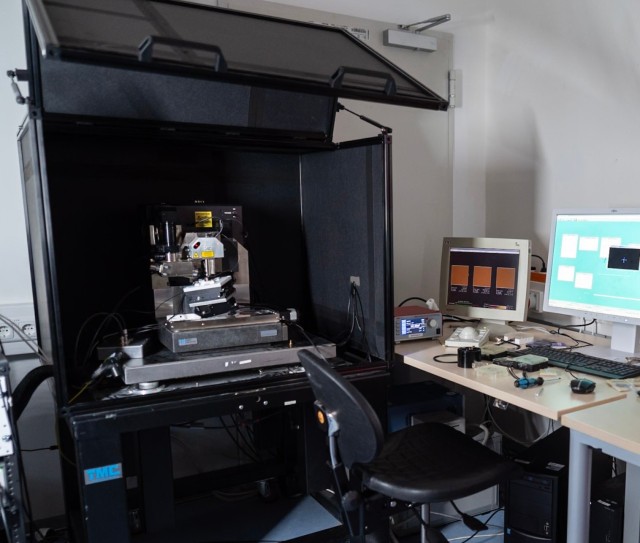
An international team of researchers led by Dmitri Efetov, Professor of Experimental Solid State Physics at LMU München's Faculty of Physics and MCQST co-coordinator for Research Area Quantum Matter, built a highly sensitive quantum microscope and used it to directly observe, for the first time at room temperature, how electrons subtly interact with each other in graphene — confirming a decades-old theoretical prediction with remarkable precision.
In recent years, "moiré materials" — atomically thin, two-dimensional layered structures such as graphene — have emerged as one of the most exciting frontiers in condensed matter physics. By stacking these atomic layers with a slight rotational misalignment, researchers create interference patterns that fundamentally reshape how electrons move. This simple twist can unlock entirely new quantum phases, including superconductivity and correlated insulating states, making moiré systems a powerful platform for exploring emergent physical phenomena.
Studying these systems, however, has traditionally come with significant technical hurdles. Conventional devices must be assembled with extreme precision, relying on fixed twist angles, painstakingly assembled with precision often better than a tenth of a degree. Even then, imperfections such as strain and disorder can obscure the underlying physics. The quantum twisting microscope (QTM) — recently pioneered by researchers at the Weizmann Institute — offers a radically different approach. By mechanically separating two-dimensional layers and rotating them in place, the QTM enables continuous, dynamic control of the twist angle, bypassing the constraints of conventional fabrication.
Pushing the boundaries of precision
 © MCQST
 What makes the result especially striking is that these interaction effects are observed at room temperature, a regime where such delicate quantum corrections are typically washed out by thermal noise. The findings not only confirm the persistence of strong electron interactions in graphene, but also demonstrate the extraordinary sensitivity and precision of the QTM platform. With dynamic twist control and unprecedented resolution, the technique is poised to become a cornerstone tool for exploring complex quantum states across moiré and other two-dimensional material systems.
Publication
Revealing Electron–Electron Interactions in Graphene at Room Temperature with a Quantum Twisting Microscope
M. Lee, I. Das, J. Herzog-Arbeitman, J. Papp, J. Li, M. Daschner, Z. Zhou, M. Bhatt, M. Currle, J. Yu, Y. Jiang, M. Becherer, R. Mittermeier, P. Altpeter, C. Obermayer, H. Lorenz, G. Chavez, B. T. Le, J. Williams, K. Watanabe, T. Taniguchi, B. A. Bernevig, Dmitri K. Efetov.
Nano Lett. 2026