MCQST Master's Awards 2025
6 May 2026
Alessandro Palermo and Philipp Westhoff win the MCQST 2025 Master’s Awards
The MCQST Master's Award recognizes two exceptional Master's theses from the MCQST community each year. This prestigious prize serves to acknowledge and celebrate outstanding research projects undertaken by talented Master's students, with the intention of inspiring and motivating the awardees to pursue successful careers in the field of science.
From the submitted theses, the jury selected and awarded two outstanding works in 2025: "Towards Single Photon Detection with Atomically Flat Materials" by Alessandro Palermo (TUM) and "A method to investigate many-body Liouvillian spectra beyond the steady state" by Philipp Westhoff (LMU). Alongside the recognition of their excellent contribution to the MCQST scientific community, the awards consist of €1000 each, generously donated by Zurich Instruments.
The award ceremony took place during the a special award ceremony on 21 April at the Max Planck Institute of Quantum Optics, where the Master's Award was celebrated for the fourth time.
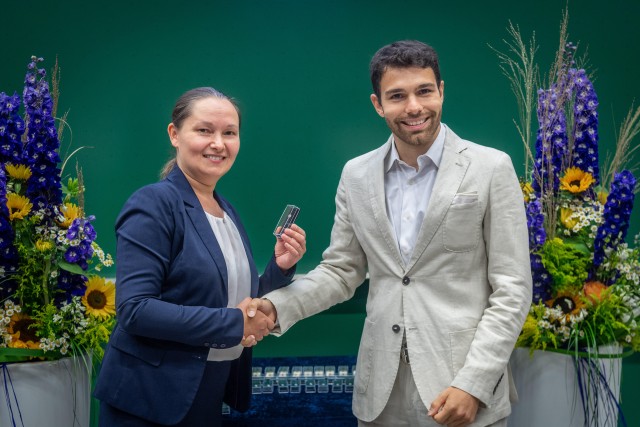 © Andreas Heddergott / TUM
 Alessandro Palermo
Towards Single Photon Detection with Atomically Flat Materials
TUM | Supervisor: Kai Müller
Alessandro’s thesis focused on demonstrating a superconducting nanowire single-photon detector (SNSPD) made from niobium diselenide (NbSe2), a two-dimensional material.
As quantum technologies are based on the manipulation of single atoms or particles, SNSPDs are the state of the art technology for detecting single quanta of light: photons. In an operational SNSPD, current flows without resistance, but when a photon is absorbed, the transferred energy breaks the superconducting state, generating a voltage pulse which indicates a detection event.
Theoretical models suggest that the thinner the superconducting material, the more sensitive the detector will be to low-energy photons. Therefore, it is appealing to realize a detector with the thinnest materials in the world: two-dimensional materials. The specific material of choice, NbSe2, remains superconductive even when thinned down to a single layer, just 3-atoms thick.
The thesis then brings together the world of SNSPDS with that of 2D materials, developing an apposite nanofabrication flow to realize a demonstrative device. The small dimensionalities involved and the sensitivity of NbSe2 to oxidation constitutes additional challenges. From electrical and optical measurements, Alessandro showed that the device operates as an SNSPD and is capable of resolving single photons at the telecom wavelength.
"It feels extremely rewarding to see the efforts of one year of thesis recognized by the whole MCQST community, and it wouldn’t have been possible without the support of Lucio, Matteo, Prof. Kai Müller and the whole SNSPD team at WSI. The quantum community in Munich is vibrant and a source of inspiration, from student initiatives as PushQuantum to the academic and industrial realities."
What's next for Alessandro?
In June 2025, Alessandro started his PhD in the Optical Nanomaterial Group, led by Prof. Rachel Grange at ETH Zurich. His research now focuses on integrated quantum photonics in lithium niobate, specifically, he is trying to integrate heterogeneous components, such as quantum emitters and SNSPDs, on reconfigurable photonics chip. The expertise in nanofabrication techniques and quantum technologies matured during the Master’s thesis became a valuable starting point for this new experience.
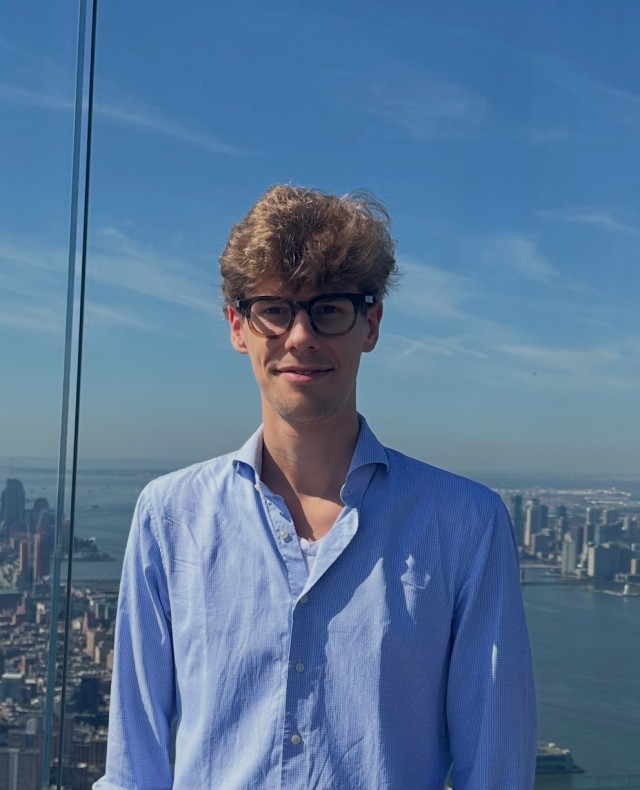 © Private
 Philipp Westhoff
A method to investigate many-body Liouvillian spectra beyond the steady state
LMU München | Supervisor: Ulrich Schollwöck
Philipp’s thesis focuses on developing new numerical methods to better understand open quantum many-body systems, systems in which quantum particles interact with an environment and exhibit complex out-of-equilibrium behavior. Such systems are central to emerging quantum technologies, but their long-time dynamics remain notoriously difficult to describe.
To address this challenge, he developed a tensor-network-based framework (CLIK-MPS) that enables access not only to steady states, but also to the slow dynamical processes that govern how these systems evolve over time, opening the door to studying collective phenomena that are otherwise out of reach.
Using this framework, he analyzed a protocol for the dissipative preparation of Bose-Einstein condensates in optical lattices. He showed that the relaxation dynamics exhibit anomalous behavior connected to the Kardar-Parisi-Zhang universality class, revealing interesting links between driven quantum systems and classical non-equilibrium physics.
In addition, he demonstrated that certain specially prepared initial states can reach the steady state significantly faster than generic ones, an effect closely related to the quantum Mpemba effect. This result establishes the phenomenon in a genuine many-body regime, where it had previously remained elusive.
Overall, this work establishes a versatile computational framework for open quantum systems and uses it to uncover novel dynamical phenomena in dissipative state-preparation protocols.
"I am deeply grateful to receive this award. It means a great deal to me, as it honors not only the work that went into my thesis, but also the experiences and challenges that shaped this journey. Working on this project has been both demanding and incredibly rewarding, and I am grateful for everything I have learned along the way. I would especially like to thank my supervisor, Ulrich Schollwöck, for his continuous support, as well as Sebastian Paeckel and Mattia Moroder for their guidance and patience throughout this process."
What's next for Philipp?
Philipp starts as a PhD student in the group of Ulrich Schollwöck, where he continues the research on numerical methods for open quantum systems. A central piece of this project will be the exploration of the numerical methods designed in his Masters thesis for the analysis of dissipative phase transitions and dissipative state preparation, with a strong focus on the impact of non-Markovian environments.
Congratulations to Alessandro and Philipp, and all the best for their future!
Further reading
- Master's Awards 2024
- About the MCQST Master's Prize
- Discover the Master in QST Program