Ignacio Cirac receives Feynman Prize
22 April 2026
ICTP and IBM recognize quantum computing pioneer Ignacio Cirac
Ignacio Cirac, MCQST co-Speaker and Director of the Max Planck Institute of Quantum Optics is awarded the inaugural ICTP–IBM Richard Feynman Prize in Quantum Computing. The award recognizes his seminal contributions to quantum optics, quantum information science, quantum many-body theory, condensed matter theory, and mathematical physics. The prize committee acknowledges his central role in establishing the theoretical foundations of quantum information processing — including entanglement theory, quantum simulation, and tensor-network methods — whose influence spans both experimental realization and theoretical progress across modern physics.
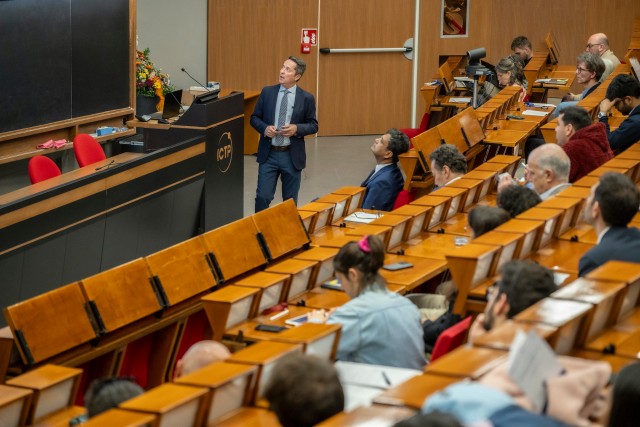 © Alberto Riccio Bergamas / ICTP Photo Archive
 The first ICTP-IBM Richard Feyman Prize for Quantum Computing was awarded during a dedicated ceremony on 21 April 2026 at the ICTP. At the event, Ignacio Cirac gave a lecture on “Quantum computers and many-body states,” discussing how small-scale quantum computers and simulators can help us address challenging problems in many-body physics.
About the Award
The ICTP-IBM Richard Feynman Prize in Quantum Computing was established jointly by the Abdus Salam International Center for Theoretical Physics and IBM in 2025. It is awarded to established career researchers who have made significant contributions to quantum computing, including theory, algorithms, applications, or simulations. The ICTP-IBM Richard Feynman Prize in Quantum Computing, named in honor of quantum mechanics pioneer Richard Feynman, is open to established career researchers who have made significant contributions to the field of quantum computing, including theory, algorithms, applications, or simulations. It is intended to be a top award in its field.
Source: Text adapted from the ICTP announcement.
Watch the ICTP Distinguished Conversations with Ignacio Cirac, ICTP Director Atish Dabholkar and ICTP quantum researcher Marcello Dalmonte. In this interview, the hosts talk with Cirac about his role in bridging fundamental concepts in quantum mechanics with their technological applications, particularly through his contributions to entanglement theory, quantum simulation, and tensor-network methods.