Hidden order in quantum chaos: the pseudogap
28 January 2026
Ultracold atoms reveal how subtle magnetic patterns shape one of the most puzzling states of matter
A team of physicists led by the group of Immanuel Bloch have uncovered a link between magnetism and the so-called pseudogap, a mysterious phase of matter that appears in certain strongly-correlated materials just above the temperature at which they become superconducting. Using an ultracold atom quantum simulator, researchers discovered a universal pattern in how magnetic correlations evolve as the system cools – an important step towards understanding unconventional superconductivity. The findings, published in the Proceedings of the National Academy of Sciences (PNAS), were a collaboration of scientists from MCQST and the Simons Foundations’ Flatiron Institute.
Superconductivity – the ability to carry electricity without resistance – has driven decades of research. Yet, in many high-temperature superconductors, the transition to this state is not abrupt. Instead, the material first enters a curious intermediate regime known as the pseudogap, in which electrons start behaving in unusual ways, and fewer electronic states are available for conduction. Understanding the pseudogap is widely considered essential for unravelling the mechanisms behind superconductivity and designing materials with improved properties.
In typical, undoped systems, electrons arrange themselves in an orderly magnetic pattern known as antiferromagnetism, in which neighbouring electron spins point in opposite directions – like dancers following a precise left-right-rhythm. But when electrons are removed, a process known as doping, this magnetic order becomes strongly disrupted. For a long time, researchers assumed that doping destroys long-range magnetic order entirely. The new study in PNAS, however, shows that at extremely low temperatures, a subtle form of organisation remains, hidden beneath the apparent disorder.
From chaos to universal order
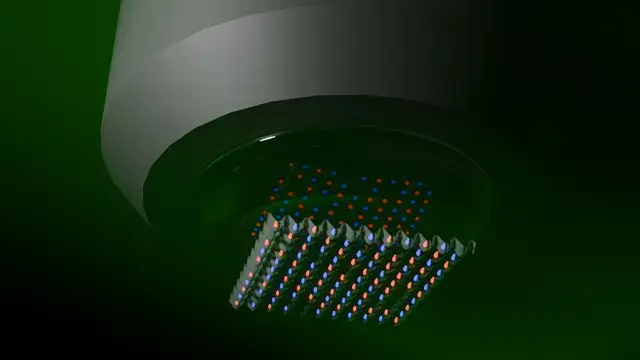
To explore this behaviour, the research team turned to the Fermi-Hubbard model, a well-established theoretical framework that captures how electrons interact inside a solid. Rather than working with real materials, the team recreated the model using lithium atoms cooled to billionths of a degree above absolute zero. The atoms were arranged in a precisely controlled optical lattice made of laser light.
Such ultracold atom quantum simulators allow scientists to mimic complex materials under controlled conditions, something impossible in traditional solid-state experiments. Using a quantum gas microscope – a device capable of imaging individual atoms and their magnetic orientation – the research team took more than 35,000 high-resolution snapshots of individual atoms. These images revealed both the spatial positions and magnetic correlations of atoms across a wide range of temperatures and doping levels.
The results were striking: “Magnetic correlations follow a single universal pattern when plotted against a specific temperature scale,” explains lead author Thomas Chalopin. “And this scale is comparable to the pseudogap temperature, the point at which the pseudogap emerges”. In other words, the pseudogap is linked to the subtle magnetic patterns hidden behind the apparent chaos.
The study also revealed that electrons in this regime do not simply interact in pairs. Instead, they form complex, multi-particle correlated structures. Even a single dopant can disrupt magnetic order over a surprisingly large area. Unlike previous studies, which focused on correlations between two electrons at a time, the new study measured correlations involving up to five particles simultaneously – a level of detail achieved by only a handful of labs worldwide.
Revealing hidden order
For theorists, these results provide a new benchmark for models of the pseudogap. More broadly speaking, the new findings bring scientists closer to understanding how high-temperature superconductivity emerges from the collective behaviour of interacting, “dancing” electrons. “By revealing the hidden magnetic order in the pseudogap, we are uncovering one of the mechanisms that may ultimately be related to superconductivity,” Chalopin explains.
The study also highlights the power of collaboration between experiment and theory. By combining detailed theoretical predictions with highly controlled quantum simulations, the researchers were able to identify patterns that would otherwise remain concealed.
The research is the product of an international collaboration, combining experimental and theoretical expertise. Future experiments aim to cool the system even further, search for new forms of order, and develop novel ways of observing quantum matter from fresh perspectives.
Publication
Observation of emergent scaling of spin-charge correlations at the onset of the pseudogap
T. Chalopin, P. Bojović, S. Wang, T. Franz, A. Sinha, Z. Wang, D. Bourgund, J. Obermeyer, F. Grusdt, A. Bohrdt, L. Pollet, A. Wietek, A. Georges,T. Hilker, & I. Bloch
Proc. Natl. Acad. Sci. U.S.A. 123 (4) e2525539123 (2026).
DOI: https://doi.org/10.1073/pnas.2525539123
Source: MPQ Website