The Quantum Bead Game
21 November 2025
Exact visualization provides intuitive access to the quantum world
The Quantum Bead Game
A novel representation makes fascinating quantum phenomena such as “superposition” and “entanglement” astonishingly easy to visualize and to literally grasp. Unlike general metaphors such as “Schrödinger's cat,” the BEADS representation is based on an exact mapping between quantum physics and spheres (or "beads") with characteristic color shades that reflect the probabilities of measurement results.
Many research groups around the globe are exploring ways to develop more and more powerful quantum computers that are based not on the processing of bits but of quantum bits (qubits for short). This is expected to enable computations that are far beyond the reach of our current computer architectures. But how do quantum computers work, and is it even possible to explain this to someone without a deep background in physics? In fact, so far, many experts believed that it is, in principle, impossible to clearly and correctly represent quantum states in an intuitive way, i.e. without using a highly abstract mathematical description (see quotes in Info Box 1).
 © S. Glaser / TUM
 A new mapping makes quantum information visible and tangible
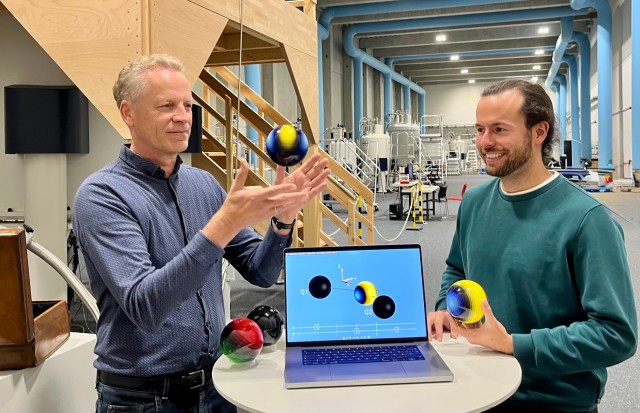
What if this mathematically encoded information could be translated without any loss into clear and easy-to-interpret images or even tangible models that can be touched and handled? A paper by Prof. Steffen Glaser from the Technical University of Munich and his colleague Dr. Dennis Huber in the current issue of the New Journal of Physics impressively illustrates that this is indeed possible. The researchers have developed an exact mapping, where a given number of qubits are represented with the help of the same number of special red-green colored spheres, called Quantum-Beads or simply Q-Beads. This means that, for example, a quantum state of three qubits can be represented with the help of three Q-Beads. However, by far the greatest share of information that can be stored in a quantum computer is not localized on the individual qubits but resides in the entanglement between the qubits.
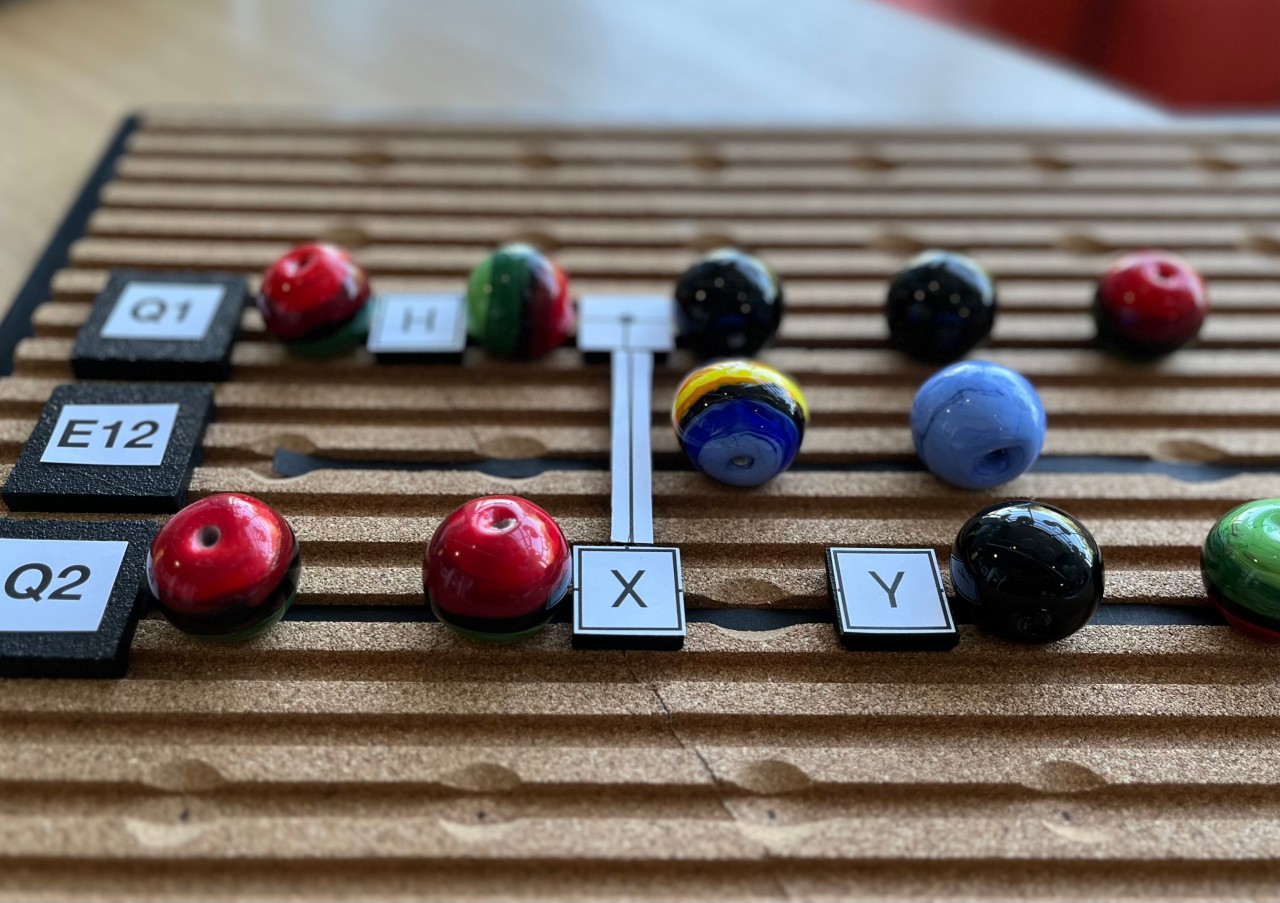
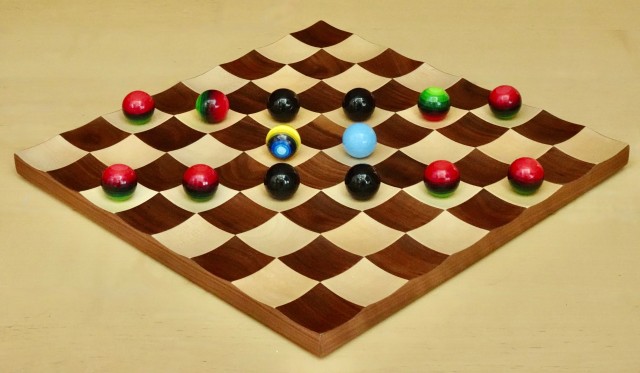
As the Munich researchers have shown, it is also possible to completely and uniquely map the information encoded in the entanglement onto a separate set of yellow-blue colored spheres, called Entanglement-Beads or simply E-Beads. Each E-Bead connects two or more Q-Beads, thus making also the strength and type of entanglement between the qubits visible and the set of Q-Beads and E-Beads form the so-called BEADS representation.
 © S. Glaser / TUM
 The BEADS representation helps illustrate and explore quantum phenomena in a playful way
The characteristic color patterns of the Q-Beads and E-Beads are not only memorable but also allow one to accurately predict the probability of measurement results. In addition, all basic processing steps of a quantum computer correspond either to simple rotations or other visual transformations of the beads. Overall, the BEADS representation makes it possible to view the previously purely abstract description of quantum information processing as a kind of game—with Q-Beads and E-Beads beads as game pieces and a manageable number of simple rules. This “Quantum Bead Game” can now be used to illustrate and to explore quantum information processing in a playful way.
 © S. Glaser / TUM
 For an illustrative example of the use of the BEADS representation to introduce important quantum mechanical concepts in a surprisingly simple, visual way, see Info Box 2.
Publication
Dennis Huber and Steffen J. Glaser
BEADS: a canonical visualization of quantum states for applications in quantum information processing
New Journal of Physics 27, 094509 (2025)
DOI: 10.1088/1367-2630/ae0514
Contact
Prof. Dr. Steffen Glaser
TU München, School of Natural Sciences
Munich Center for Quantum Science and Technology (MCQST),
Munich Quantum Valley (MQV),
Bayerisches NMR Zentrum (BNMRZ)
Email: glaser[at]tum.de
INFO BOX 1
Some quotes on the “impossibility” of a vivid visual language for quantum physics
In his 2008 book Die sonderbare Welt der Quanten (The Strange World of Quanta), physics professor Jürgen Audretsch stated the commonly held believe that the desire of physics laymen for clarity is “unfortunately impossible to fulfill in principle”: “What makes the understanding of quantum theory so difficult is its lack of imagery. In its framework, there is no intuition evoked by memorable images and metaphors, but only the power of mathematical formulation.” Already 80 years earlier, the editors of Nature magazine in 1928 felt compelled to accompany a foundational paper by Niels Bohr with the following comments: “It must be confessed that the new quantum mechanics is far from satisfying the requirements of the layman who seeks to clothe his conceptions in figurative language. Indeed, its originators probably hold that such a symbolic representation is inherently impossible. It is earnestly to be hoped that this is not their last word on the subject, and that they may yet be successful in expressing the quantum postulate in picturesque form.”
INFO BOX 2
“The Little Quantum Pocket Guide”
The Little Quantum Pocket Guide illustrates how the BEADS representation can be used, e.g., to provide a visual introduction to the world of qubits that is both simple and accurate. The booklet was developed in collaboration with the Munich Center for Quantum Science and Technology (MCQST) and introduces basic quantum mechanical concepts such as superposition, entanglement, and measurements.